
A history of science By Bob Kowalski
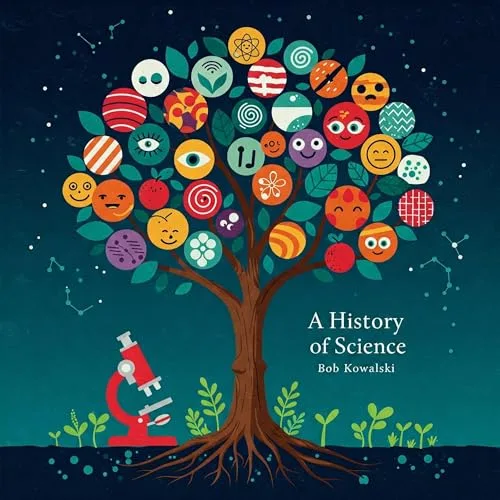
- Narrated by: Virtual Voice
- Length: 5 hrs and 13 mins
- Release date: 11-26-25
A history of science By Bob Kowalski AudioBook Summary
“A History of Science” is a monumental work that traces the evolution of science from its origins in ancient civilizations to the contemporary challenges faced in the 21st century. With a comprehensive and well-structured approach, the author takes the reader on a fascinating journey that reveals how human curiosity and the desire to understand the world shaped the development of scientific knowledge. The narrative begins with a delve into the scientific practices of Egypt, Mesopotamia, China and India, highlighting how Babylonian mathematics and astronomy laid the foundations for future studies. The author emphasizes the deep practical understanding of nature in the fields of medicine and engineering in Ancient Egypt. This initial exploration is fundamental to understanding the importance of ancient civilizations in the formation of scientific knowledge. Moving forward to Ancient Greece, the work introduces iconic figures such as Thales, Pythagoras and Aristotle, who not only questioned the world around them, but also formalized methods of investigation. The contributions of Ptolemy and Hipparchus to astronomy, as well as the medicine of Hippocrates and Galen, establish a legacy that still resonates in contemporary science. The author also reveals the significant impact of Islamic science, which preserved and expanded Greek knowledge, especially in the areas of algebra and optics. The development of universities in Medieval Europe and innovations such as the invention of paper and gunpowder in China highlight the continuity and interconnectedness of scientific knowledge across cultures. The Renaissance is presented as a period of rediscovery and innovation, where the Copernican Revolution challenges the geocentric model. The author discusses the contributions of figures such as Vesalius in anatomy and Leonardo da Vinci in technology, highlighting the importance of observation and experimentation. The Scientific Revolution of the 17th century marks a pivotal moment, with the introduction of the scientific method of Bacon and Descartes and the contributions of Kepler, Galileo and Newton that revolutionized physics and astronomy. The author illustrates how these changes led to a new understanding of the universe, based on reason and evidence.
The impact of the Enlightenment in the 18th century and the discoveries of Lavoisier and Franklin are decisive moments for modern science, highlighting the connection between science and philosophy, exemplified by Kant. In the 19th century, the work portrays the expansion of knowledge, with Darwin’s theory of evolution challenging traditional views and Mendeleev’s chemistry shaping the periodic table. The emergence of geology reveals the antiquity of the Earth, expanding human understanding of its place in the universe.
The 20th century is dramatized by Einstein’s theories and advances in molecular biology, with a space race expanding the limits of technology and awakening a new era of exploration and discovery. The technological and digital revolution is addressed with a focus on the impact of computing and the internet, as well as innovations in nanotechnology and biotechnology, which challenge the frontiers of science.
Download
https://rg.to/file/d7e6b7023e85fb933460780e09466781/Bob_Kowalski_-_A_History_of_Science.m4b.html


